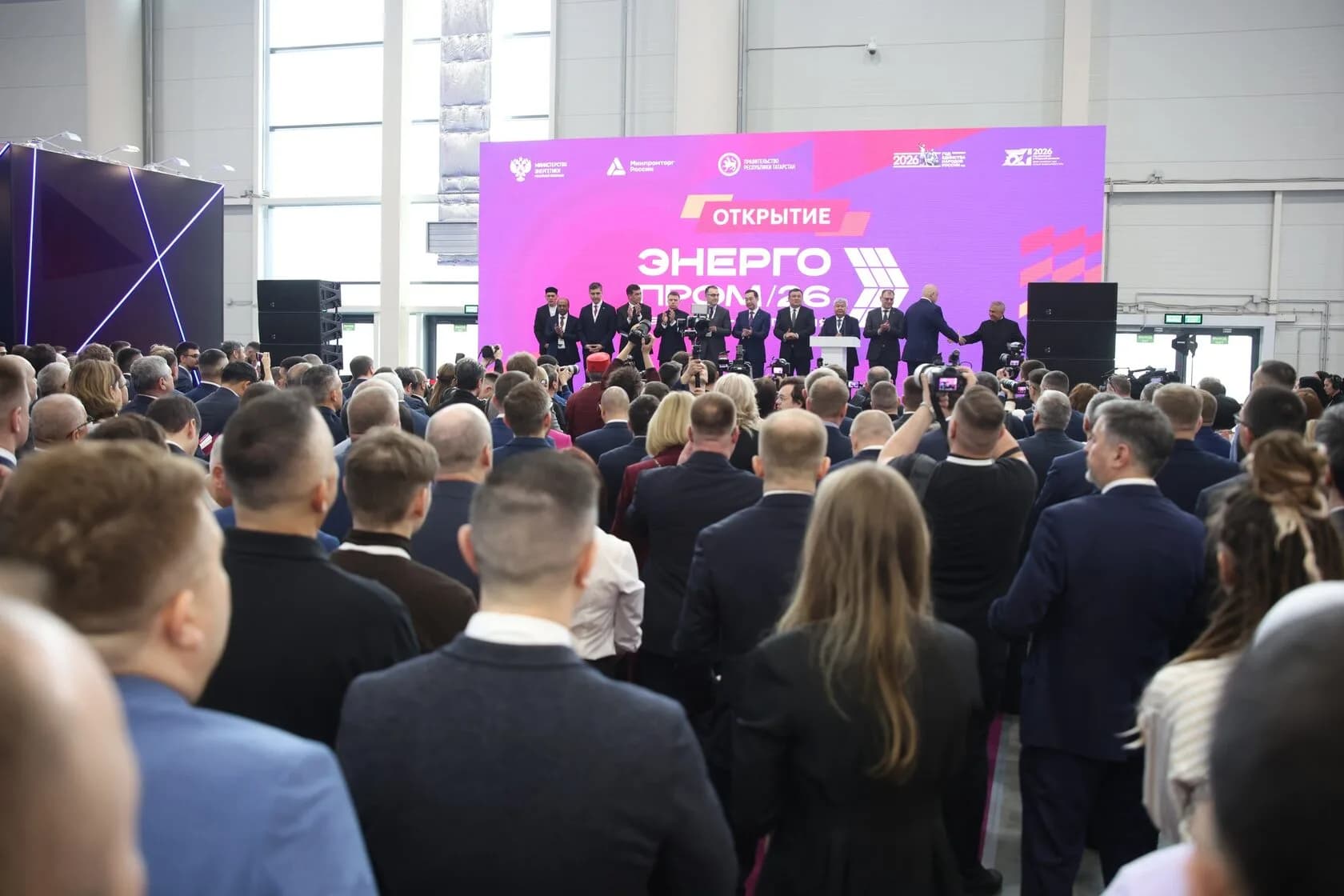
The central event of the Kazan International Electric Power Forum ENERGOPROM was the plenary session "GOELRO VER.2.0: Revival of a Legend", held on 2 April. Here are its key outcomes.
The theme set a high tone for the entire discussion. The session moderator, Alexandra Panina, Chair of the Supervisory Board of the Council of Power Producers Association, recalled that the historic GOELRO plan had become not merely an industry document but the foundation of the country's economic breakthrough. Today, in her words, the power industry faces a task of comparable scale — to build a new power system: resilient, technologically independent and ready for the challenges of the future. At the centre of the discussion were not only technologies, but also economics, investment, international cooperation and the role of the energy sector in the global transformation.
Rustam Minnikhanov, Rais (Head) of the Republic of Tatarstan, noted in his address the particular significance of the ENERGOPROM forum, which received federal status this year, and thanked the Russian Ministry of Energy for its support and assistance in holding the event. He highlighted the high level of international participation, noting the delegations of the CIS countries and of foreign partners, and expressed confidence that open dialogue would make it possible to expand cooperation and to find new points of growth. Minnikhanov paid particular attention to the role of Tatarstan in the development of the energy sector: the republic was historically one of the centres where the GOELRO plan was implemented, and today it retains its leading position, demonstrating steady growth in industry and in power consumption. In his words, the development of high-technology production requires a further increase in generating capacity and the shaping of a new energy agenda. "By combining our knowledge and expertise, we are not simply keeping pace with global trends — we are creating the energy sector of the future", Rustam Minnikhanov said.
The key focus of the plenary session was a strategic vision for the future of the Russian energy sector. During the plenary session, Sergei Tsivilev, Minister of Energy of the Russian Federation, presented a strategic vision of the role of the energy sector in the modern world, stressing its key importance for global development. In his words, rapid technological progress — from artificial intelligence to digital solutions and new modes of transport — directly increases the need for energy, making the energy sector the basis of the economy and of the quality of life. The Minister noted that, as technological paradigms change ever faster, competition for energy resources is intensifying, which is reflected in international politics. In this situation Russia, in his words, offers an alternative path — development based on technological sovereignty, partnership with friendly countries and the principles of energy justice. Sergei Tsivilev paid particular attention to the need to shape a new long-term programme for the development of the industry, comparable in scale to the GOELRO plan. He stressed that this is a matter of a systemic transformation of the energy sector, which will become the foundation of the country's economic growth and of its future, and that it can be delivered only by combining the efforts of the state, business and society. "It is the energy sector that today determines what our state will be, what the world will be and what the standard of living of people will be. We are offering the world a different approach — not pressure and sanctions, but the principles of energy justice, technological sovereignty and joint development. This is the path to the future that we must travel together," said Sergei Tsivilev.
Particular attention was given to international cooperation. Viktor Karankevich, Deputy Prime Minister of the Republic of Belarus, presented the country's experience in developing its energy industry and in delivering one of its key infrastructure projects — the Belarusian Nuclear Power Plant. He noted that the construction of the Belarusian NPP had become the largest joint project of Belarus and Russia and had a significant impact on strengthening the country's energy self-sufficiency and on the development of related industries. The project helped to build new competencies, to develop scientific and engineering schools and to create modern infrastructure. According to Viktor Karankevich, the Belarusian NPP today covers about 40% of the country's electricity demand and has also made it possible to reduce substantially the dependence on imported energy resources and to achieve a significant environmental effect. "In effect, an entire industry has been created: specialists have been trained, the necessary infrastructure has been put in place, and new competencies have been mastered not only in nuclear power but in related industries as well. Today our scientific and engineering schools, our design, engineering and construction organisations have the experience and knowledge that are in demand both inside the country and abroad," said Viktor Karankevich.
Jurabek Mirzamakhmudov, Minister of Energy of Uzbekistan, shared the experience of the rapid growth of the national power system. In recent years the country's installed capacity has almost doubled, and the share of green generation is steadily rising. At the same time, the key task remains the balance between the resilience of the power system and the development of renewable sources. The issue of technological independence was one of the central themes of the discussion. Mikhail Ivanov, Russian Deputy Minister of Industry and Trade, noted that the industry faces a twofold challenge: to meet domestic demand for equipment and at the same time to enter export markets. The development of domestic power equipment manufacturing is directly linked to the delivery of large-scale energy projects. Also taking part in the plenary session were Andrey Petrov, a representative of Rosatom, Maxim Bystrov, Chairman of the Management Board of the NP Market Council Association, Fedor Opadchy, Head of the System Operator of the UPS, Pavel Snikkars, CEO of T Plus, and Ruslan Gizzatullin, member of the Management Board of SIBUR Holding. The plenary session was not simply a discussion of current challenges but an attempt to shape an image of the future of the Russian energy sector — systemic, technologically advanced and focused on long-term development.